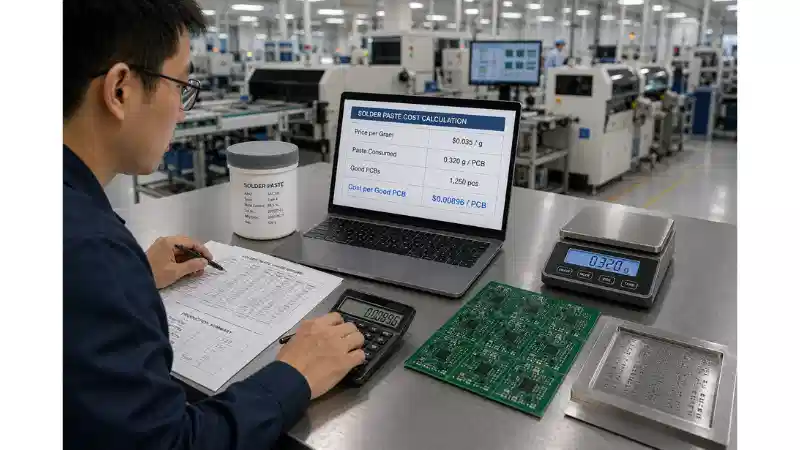
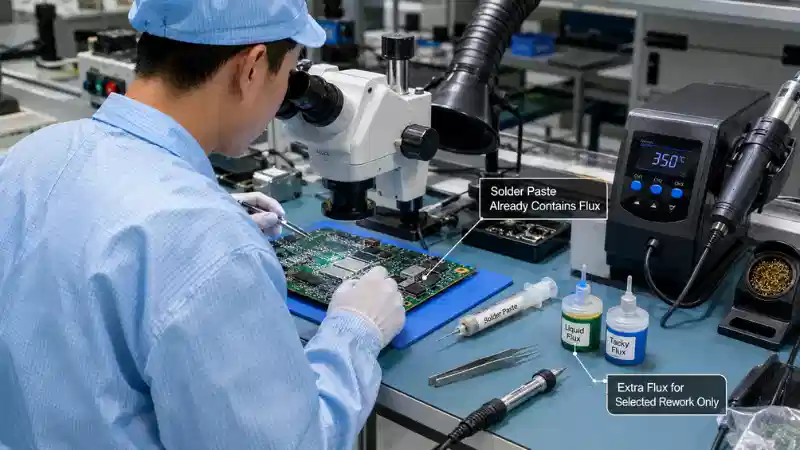
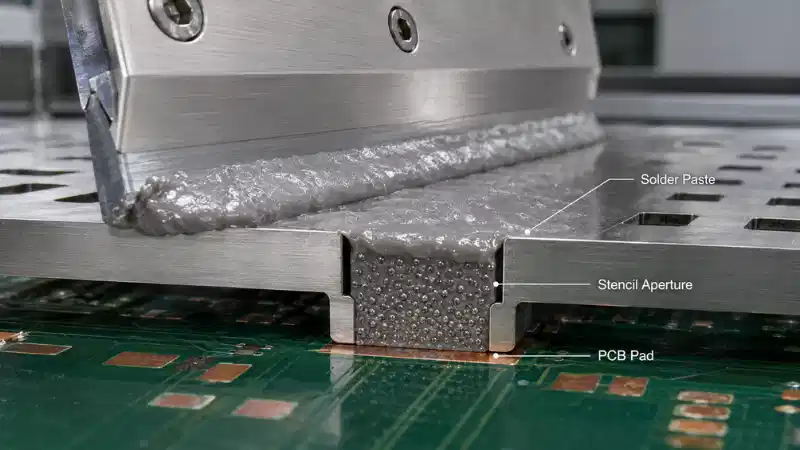
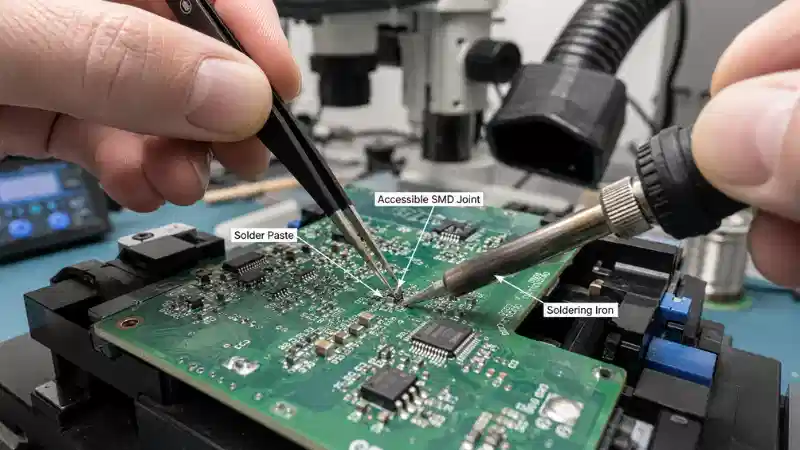
Solder paste already contains a flux vehicle, so a normal SMT printing and reflow process should not require an operator to add another flux as a routine step.

Extra flux can still be useful in selected repair and rework operations. The important distinction is how it is used. Mixing a separate flux directly into a solder paste jar or syringe changes the original formulation. Applying a small amount of compatible flux locally to an existing solder joint is a different process and may be appropriate.
Before adding anything, ask: Does the joint need more solder metal, or does the existing solder only need help wetting and flowing?
If solder volume is missing, use a controlled solder source such as fresh solder paste, solder wire or an approved preform. Flux can support wetting, but it cannot replace missing alloy.
Quick Answer
Extra flux is usually unnecessary when fresh solder paste is applied to clean pads and processed within its validated application and reflow window.
Separate flux may help when:
- existing solder is being reheated;
- an oxidized joint is being touched up;
- solder wick is being used to remove old solder;
- a component is being removed;
- a validated BGA or QFN rework process relies on existing solder or pre-tinned surfaces.
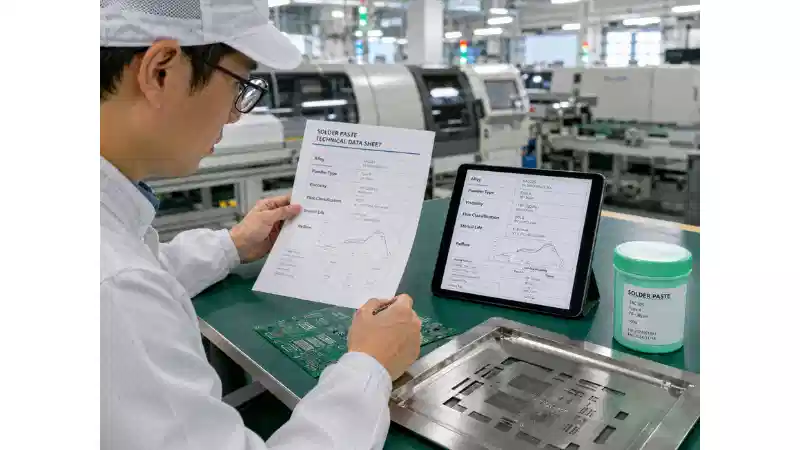
Do not pour liquid, gel or tacky flux into the original paste container unless the paste supplier has explicitly approved that modification. The altered material no longer matches the original technical data sheet.
"Adding Flux" Can Mean Two Different Things
Mixing Flux into the Paste
This means adding an independent liquid, gel or tacky flux to a jar or syringe of solder paste and stirring the materials together.
That action changes a controlled formulation. Even when the paste looks easier to spread afterward, its metal content, viscosity, tack, slump resistance, outgassing and residue behavior may no longer match the supplier's stated properties. For production use, an altered paste should be treated as an unqualified material.
Applying Flux Separately at the Rework Site
This means placing a controlled amount of flux on a pad, lead or existing solder joint without modifying the paste container.
Local application can help oxide removal and wetting when enough solder is already present. It still requires compatible chemistry, controlled placement, adequate heating and a residue or cleaning plan.
The detailed comparison of flux paste and solder paste explains why the two materials are related but not interchangeable.
Why Solder Paste Already Contains Flux
Solder paste is not simply alloy powder mixed with a generic cleaner. Its flux-containing vehicle helps the complete material:
- remove or disrupt oxides during heating;
- protect exposed metal from rapid reoxidation;
- keep solder powder distributed through the material;
- achieve suitable flow under printing or dispensing force;
- fill and release from the intended deposit geometry;
- retain shape and hold components before reflow;
- manage solvents and reaction products during heating.
The balance among powder, flux vehicle and metal content is central to the working principle of solder paste. A printing paste, dispensing paste and jetting paste can contain similar alloy powder but behave differently because the complete formulations are optimized for different shear and deposition conditions.
Liquid Flux vs. Tacky Flux for Rework
The phrase extra flux can refer to materials with very different handling behavior.
| Flux Form | Typical Handling Characteristic | Where It May Be Useful | Main Control Point |
|---|---|---|---|
| Liquid flux | Flows and spreads readily | Accessible lead touch-up, solder-wick assistance and localized joints | Prevent uncontrolled spreading beyond the heated area |
| Gel or tacky flux | Stays in place and may help stabilize a component | Selected hot-air, BGA or bottom-terminated package rework processes | Control volume, heating coverage and hidden residue |
Neither form is universally better. Selection depends on the rework method, alloy, package geometry, heating coverage, cleaning process and reliability requirement. The guide to choosing the right solder flux provides additional selection guidance.

When Extra Flux Is Usually Unnecessary
Another chemistry should not be the first response when:
- the paste is within its documented shelf life;
- storage and warming followed the product instructions;
- pads and terminations are clean and solderable;
- the correct deposit volume was applied;
- the paste matches the alloy and application method;
- the reflow profile has been measured on the actual assembly;
- the board has not received repeated uncontrolled heating.
If fresh paste does not wet or reflow correctly, extra flux may hide the actual cause. Possible causes include contamination, an unsuitable alloy, incomplete heating, excessive delay before reflow, incorrect deposit volume, damaged finish, poor storage or material separation.
Review the solder paste shelf life and handling requirements before trying to change the chemistry.
When Separate Flux May Be Useful
Reheating Existing Solder
A joint may already contain enough solder but no longer wet or flow easily because the exposed surface has oxidized. A small quantity of compatible flux can assist reheating without adding unnecessary metal volume.
Examples include retouching a visible lead, correcting a small bridge, reheating a pre-tinned pad or restoring flow during localized hand soldering.
Component Removal
Tacky flux is often used around multi-lead packages during a validated hot-air removal process. It supports reflow of the existing joints, while removal still requires complete joint melting and controlled lifting.
Pad Preparation and Solder Wick
Flux can help existing solder wet the braid and transfer away from a pad. After wicking, inspect the land pattern. When the replacement component requires a defined solder volume, apply a controlled solder source rather than relying on residual metal.
BGA and QFN Rework
A BGA already carries solder balls, so some approved rework processes use tacky flux on prepared pads. A QFN or another bottom-terminated package may require a controlled paste pattern when the thermal pad or peripheral lands do not contain enough solder.
The package name alone does not determine whether paste or flux is correct. Follow the component supplier's rework guidance, the approved thermal process and the required inspection method, including X-ray where hidden joints must be evaluated.

When You Need Solder Paste, Not Flux
Use solder paste or another approved solder source when:
- a new component is being assembled on bare pads;
- the original solder was removed during cleaning;
- an open joint is caused by insufficient solder volume;
- a thermal pad needs a controlled alloy deposit;
- stencil printing or dispensing is intended to deliver repeatable volume;
- joint geometry requires solder beneath the component.
For processes requiring controlled deposits, review the available solder paste products and the article on solder paste application methods.
What Changes When Flux Is Mixed into Solder Paste?
| Changed Property | Possible Effect | Why It Matters |
|---|---|---|
| Metal content | Less alloy remains in the same deposit volume | The final joint may contain less solder than expected |
| Viscosity and rheology | The paste may smear, slump or release differently | Printing and deposit control may no longer match the approved process |
| Tack | Components may move more easily before or during heating | Placement stability can change |
| Solvent and outgassing behavior | Additional volatile material may be present | Spattering, solder balls, residue or voiding may change depending on geometry and profile |
| Residue chemistry | Different resins, activators or cleaners may interact | Cleaning and long-term reliability require reevaluation |
| Traceability | The supplier's TDS no longer describes the altered material | The modified paste cannot be treated as the original qualified product |
A paste that looks dry or unusually stiff is not automatically expired; temperature, exposure time, formulation and storage history can all affect appearance. The correct response is to investigate the documented handling condition, not to restore the material by adding unapproved flux.
The article on solder paste physical properties explains why viscosity, rheology and tack must be evaluated as a complete system.
Risks of Applying Too Much Extra Flux
| Possible Effect | What Can Happen | What to Verify |
|---|---|---|
| Paste spreading | Deposits may move beyond pad boundaries and contribute to bridging | Placement, volume and whether flux has pooled beneath the paste |
| Component movement | Small parts may shift, float or rotate | Material volume, tack and heating rate |
| Spattering or solder balls | Volatile material may disturb molten solder | Applied volume, preheat and solvent escape |
| Voiding | Gas may be trapped beneath large or hidden joints | Package geometry, chemistry, heating rate and escape path |
| Unprocessed residue | Flux outside the heated area may remain partly active | Whether the complete applied area receives the intended thermal cycle |
| Downstream incompatibility | Residue may affect ICT, coating, underfill, bonding or sensitive circuitry | Cleaning, residue evidence and the reliability requirement |
Keep extra flux localized to the surfaces requiring activation. Avoid creating a pooled layer beneath a controlled paste deposit unless that exact rework method has been validated.
Mixed Flux Residues: A Balanced Compatibility Check
A PCB may contain residues from solder paste, flux-cored wire, liquid rework flux, tacky flux and other soldering processes. Multiple no-clean materials do not automatically create a reliability failure, but compatibility should not be assumed when residues interact.
Evaluate:
- whether each material has appropriate reliability evidence for its intended process;
- whether every applied material received the required thermal exposure;
- whether mixed or hidden residue can be cleaned when cleaning is required;
- whether residue will contact conformal coating, underfill, high-impedance circuits or test probes.
Material classification alone does not prove compatibility with another residue system. For halogen-controlled applications, review the process requirements associated with high-reliability zero-halogen solder paste.
Where a fully washable process is required, a purpose-designed washable SMT solder paste may be more suitable than combining unrelated chemistries.
Decision Table: Paste or Extra Flux?
| Situation | First Material to Consider | Reason |
|---|---|---|
| Bare pads need a new SMD component | Solder paste | Solder metal must be deposited |
| An existing joint has enough solder but wets poorly | Compatible flux | Surface activation may be needed |
| Old solder is being removed with wick | Flux | It supports solder transfer into the braid |
| Paste appears separated, expired or outside its approved condition | Investigate and replace when required | Extra flux does not restore the qualified formulation |
| A BGA with existing solder balls is being replaced | Approved tacky-flux rework process | The balls provide solder metal |
| A QFN thermal pad lacks solder volume | Controlled solder paste deposit | Flux cannot supply the missing alloy |
| Stencil printing has poor release | Investigate paste, stencil and printer conditions | Added flux changes rheology and may hide the cause |
| A rework area contains mixed residues | Verify compatibility and cleaning | Reliability depends on the complete residue system |
Illustrative Rework Scenario
The following example is hypothetical and is included only to demonstrate the decision process.
A visible gull-wing lead contains enough solder, but the joint surface is dull and does not reflow cleanly during touch-up. Inspection shows no lifted pad, missing metal or contamination requiring board repair.
In this situation, a small quantity of compatible local flux may be more appropriate than adding paste. The operator should heat the complete joint area, verify wetting, inspect for bridging and confirm whether the residue may remain or must be cleaned.
If inspection instead shows that the heel or toe fillet lacks solder, the correct response is to add a controlled solder source rather than repeatedly applying flux.
Controlled Rework Procedure
- Determine whether solder metal is missing. Inspect the pads and joints under suitable magnification.
- Clean and inspect the site. Check for contamination, lifted pads, mask damage and poor surface finish.
- Select paste or flux. Use flux for wetting support when enough solder is present; use paste when controlled alloy volume is required.
- Apply the minimum controlled amount. Keep flux close to the surfaces requiring activation and paste within the intended pad geometry.
- Heat the complete applied area. Use an approved iron, hot-air or rework process that fully heats the intended joints and flux-covered region.
- Inspect, clean and record. Check wetting, bridges, solder balls, movement, residue, pad damage and opens. Record the materials, lots and heating method.
Use solder paste inspection principles when deposit quality must be verified before placement and reflow. Alloy compatibility can also be reviewed in the guide to tin solder alloys for PCB assembly.

What a Failed Rework Result May Indicate
| Observed Result | Possible Cause | Next Check |
|---|---|---|
| Joint remains open after reheating | Insufficient solder volume or damaged land | Stop adding flux and inspect the solder source and pad condition |
| Paste spreads before melting | Excess local flux, low deposit stability or overheating | Review material volume, placement and thermal process |
| Solder balls or spattering appear | Excess volatile material, contamination or aggressive heating | Review flux volume, paste condition and preheat |
| Residue remains far outside the joint | Flux spread beyond the fully heated area | Assess cleaning and restrict future placement |
| A hidden joint shows unacceptable voiding | Geometry, material volume, chemistry or escape path | Review the complete rework profile and inspect by the approved method |
Common Mistakes
- Mixing flux into an entire paste jar to solve a local problem.
- Trying to restore expired or separated paste with fresh flux.
- Flooding pads before applying a controlled paste deposit.
- Combining water-soluble and no-clean chemistries without a validated cleaning plan.
- Adding more flux when the joint actually lacks solder.
- Applying flux beyond the area that will receive sufficient heat.
- Failing to record the rework paste, flux, alloy and lot.
For more background on activation and wetting, see how solder flux supports electronics assembly.
FAQ
Q: Does solder paste already contain flux?
A: Yes. The flux vehicle is part of the paste formulation and supports oxide removal, powder distribution, rheology, tack and reflow behavior.
Q: Do I need extra flux with fresh solder paste?
A: Usually not in a validated print-and-reflow process. When wetting is poor, first investigate the surface, paste condition, deposit volume and thermal profile.
Q: Can I mix liquid flux into dry solder paste?
A: Do not use this as a routine restoration method. It changes the metal-to-flux ratio and other process properties, so the supplier's original data no longer describes the material.
Q: Should extra flux go above or below solder paste?
A: There is no universal placement rule. Keep flux localized to the surfaces that need activation and avoid a pooled layer beneath a controlled paste deposit unless that exact rework method has been validated.
Q: Can extra flux increase voiding?
A: It can change gas generation and escape, but the result also depends on package geometry, applied volume, paste chemistry and the heating profile.
Q: Should the extra flux come from the same manufacturer as the paste?
A: A supplier-recommended combination can simplify validation, but documented chemistry, process and residue compatibility matter more than brand name alone.
Conclusion
Do not routinely add flux to fresh solder paste, and do not mix an independent flux into the paste container as a shop-floor adjustment.
Use separate flux when enough solder is already present and the rework operation needs additional wetting support. Use solder paste or another controlled solder source when alloy volume is missing.
For guidance based on the alloy, paste type, flux chemistry, package, cleaning process and reliability requirement, submit the application details through the YIHMA inquiry page.