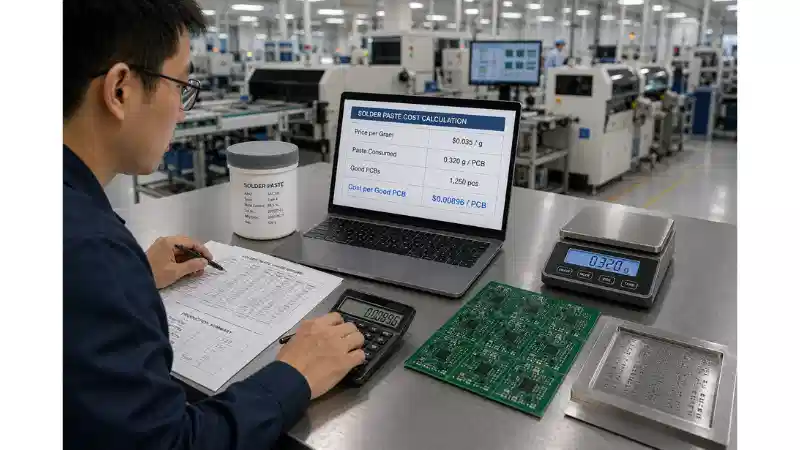
Flux paste and solder paste represent two fundamentally distinct materials in electronics assembly, though the naming convention causes persistent confusion across the industry. Flux paste contains only flux compounds-typically rosin-based or water-soluble formulations-designed exclusively for oxide removal and wetting promotion. Solder paste, by contrast, is a composite material comprising metal alloy particles suspended in a flux medium, engineered for single-step metallurgical bonding. The functional overlap in their flux components masks a critical divergence in application methodology.
Why People Keep Mixing These Up
I've seen engineers with fifteen years of experience grab the wrong tube. It happens more than anyone admits.
The problem starts with how manufacturers label things. "Paste" appears on both products. Some companies even use nearly identical packaging-same size syringes, similar color caps. You're working under magnification at 2 AM trying to rework a BGA, and suddenly you've applied flux paste where you needed solder paste. The joint looks wet, seems ready, but there's no metal to form the actual bond.
Here's what nobody tells you in training: flux paste feels different. It's generally more translucent, sometimes almost honey-like in consistency. Solder paste has that characteristic grey, grainy appearance from the suspended metal particles. Once you've handled both extensively, you can tell them apart by texture alone. But that takes time.
The Chemistry Side of Flux Paste
Flux paste formulations fall into several classification systems, with the IPC J-STD-004B standard being the most widely referenced in North American manufacturing.
- Rosin-based (RO): Traditional formulation derived from pine tree resin. The rosin activates at soldering temperatures, becoming mildly acidic to dissolve oxides. Post-soldering residues are generally benign, though they can attract dust in humid environments. Some older military specifications still mandate rosin flux exclusively.
- Organic acid (OR): Water-soluble formulations using organic acids like adipic or succinic acid. Stronger activation than rosin. Absolutely requires post-process cleaning-leave these residues on a board and you're asking for dendrite growth and eventual field failures. I learned this one the hard way on a humidity-sensor project.
- Inorganic acid (IN): Rarely used in electronics. These are the aggressive formulations you'd see in plumbing or sheet metal work. The corrosivity makes them unsuitable for sensitive components.
- Synthetic activated (SA): Modern formulations designed to mimic rosin performance with synthetic chemistry. Often marketed as "no-clean" options.
The activation temperature matters enormously, and spec sheets don't always make this clear. A flux designed for lead-free processing at 250°C won't perform identically at the 183°C eutectic point of tin-lead solder. You'll get incomplete oxide removal, poor wetting, and joints that look acceptable but fail under thermal cycling.

Solder Paste Composition
Solder paste is genuinely complicated stuff.
The metal content typically ranges from 88% to 92% by weight, though this translates to roughly 50% by volume due to density differences. The particle size distribution follows a type classification system-Type 3 (25-45 microns) remains the workhorse for most SMT applications, while Type 4 and Type 5 pastes with finer particles address the demands of 0201 components and micro-BGA packages.
The flux vehicle in solder paste serves multiple functions beyond simple oxide removal. It provides the rheological properties necessary for stencil printing-the paste needs to roll, not slide, across the stencil surface. It must release cleanly from aperture walls. It needs sufficient tack to hold components during placement. And it has to outgas cleanly during reflow without spattering.
That's asking a lot from what's essentially a sacrificial medium.
Common alloy compositions:
Tin-lead (Sn63/Pb37) remains in use for certain aerospace and military applications exempt from RoHS requirements. The 183°C melting point and excellent wetting characteristics made it the industry standard for decades.
SAC305 (96.5% tin, 3% silver, 0.5% copper) emerged as the dominant lead-free alternative. Higher melting point around 217-220°C. The silver content raises material costs but improves thermal fatigue resistance.
Low-temperature alternatives like Sn42/Bi58 (138°C melting point) are gaining traction for heat-sensitive assemblies. The bismuth makes joints somewhat brittle, which limits applications.
Practical Application Differences
Flux paste goes on before and during rework operations. You're using it to prepare surfaces, enable wetting, or facilitate solder flow in hand-soldering scenarios. It's a process aid, not a joining material.
A typical rework sequence: apply flux paste to the site, position replacement component, reflow with hot air or focused IR. The flux cleans the existing solder, promotes coalescence, and the original solder on the pads forms the joint. No additional metal required-assuming sufficient solder volume exists.
Solder paste provides both the flux function and the metal for joint formation. It's dispensed or stencil-printed onto bare pads before component placement. The reflow cycle activates the flux, melts the alloy particles, and forms metallurgical bonds in a single thermal excursion.
The distinction seems obvious written out like this. In practice, the confusion persists because both products can produce shiny, wet-looking surfaces during heating. The difference only becomes apparent when you probe the joint or subject it to mechanical stress.

Storage and Handling Quirks
Solder paste requires refrigeration. The flux vehicle degrades at room temperature, and the metal particles can oxidize or settle. Most manufacturers specify 0-10°C storage with a 6-month shelf life. Before use, you need to allow the container to reach room temperature-opening cold paste introduces condensation that destroys print quality.
The warm-up period catches people. Four hours minimum for a 500g jar. Open it early and you've compromised the entire container.
Flux paste is more forgiving, generally stable at room temperature for 12-24 months. Some high-activity formulations may require refrigeration, but it's not universal.
Neither product tolerates freezing. The phase change disrupts the homogeneous mixture in ways that can't be recovered through re-mixing.
When Flux Paste Saves the Day
Component removal. Full stop. This is where flux paste earns its place on every rework station.
Attempting to remove a QFN or BGA without adequate flux is an exercise in frustration. The existing solder won't wet properly, the component sticks unevenly, pad damage becomes almost inevitable. A generous application of appropriate flux paste transforms the operation.
Pin-in-paste processes also benefit from supplemental flux application, though this verges into specialized manufacturing territory.
For wave soldering touchup-when you're addressing bridging or insufficient fill on through-hole joints-flux paste applied with a brush or flux pen enables clean solder flow without adding volume. There's already enough solder present; you just need it to behave.
When Only Solder Paste Works
New assembly of surface-mount components. You cannot flux-paste your way to a joint that lacks solder.
Step-soldering applications where sequential reflow cycles require precise alloy volumes. Prototype runs using dispensing equipment. Stencil printing for production volumes. Preforms are an alternative here, but paste remains dominant for standard SMT.
The particle size selection becomes critical for fine-pitch work. Attempting to print Type 3 paste through a 0.3mm stencil aperture results in inconsistent deposits and bridging defects. You need Type 4 or finer, with appropriate flux rheology to match.

Some Reflow Truths Nobody Advertises
The reflow profile for lead-free solder paste demands more precision than tin-lead ever did. The processing window narrows considerably-you need to reach liquidus, maintain it long enough for proper wetting, but avoid extended time above 250°C where intermetallic growth accelerates and components reach their thermal limits.
Flux paste used in conjunction with existing solder doesn't face identical constraints. The flux activates, does its job, and burns off. You're not trying to melt a particle distribution; you're enabling flow of already-present alloy.
This means rework profiles can differ substantially from production reflow profiles, even on the same assembly. The thermal mass is different, the solder volume is different, the flux behavior shifts.
Quality Indicators
Acceptable flux paste residue (for no-clean formulations): minimal, non-tacky, non-conductive. High humidity exposure shouldn't cause visible changes.
Acceptable solder paste joint: smooth, concave fillet geometry, complete pad wetting, no visible voids on X-ray, appropriate intermetallic thickness.
Problematic indicators for flux paste: sticky residues that attract contamination, white crystalline deposits (unreacted activators), corrosion on nearby conductors.
Problematic indicators for solder paste: grainy joint appearance (cold joint or insufficient reflow), solder balls on mask surface (excessive paste volume or profile issues), tombstoning (uneven wetting forces during reflow).
The Cost Question
Flux paste: $15-80 per kilogram depending on formulation and manufacturer. You're using relatively small quantities even in production environments.
Solder paste: $80-400+ per kilogram. The metal content drives the pricing, with SAC305 at the higher end due to silver. Specialized alloys for high-reliability applications can exceed $600/kg.
From a consumption standpoint, flux paste usage might run 50-100 grams monthly in a moderate rework operation. Solder paste consumption scales with production volume-a busy SMT line can burn through several kilograms daily.
The economics favor using each material appropriately rather than attempting substitution. Using expensive solder paste where flux paste would suffice wastes money. Using flux paste where metal addition is required wastes time and components.
Compatibility Considerations
Not all flux pastes work with all solder alloys. The activation chemistry needs to address the specific oxide species present. Lead-free oxides are generally more stubborn than tin-lead oxides, requiring more aggressive flux formulations.
Mixing flux chemistries on a single assembly creates reliability risks. A no-clean production flux followed by a water-soluble rework flux leaves residue combinations that neither cleaning process fully addresses.
The safest approach: use flux paste from the same manufacturer and chemistry family as your solder paste. If your production uses Kester R562 solder paste, use Kester flux products for rework. Cross-manufacturer combinations can work but require validation.
A Brief Word on Tackifiers
Some operators use flux paste as a component adhesive, exploiting its tackiness to hold parts during handling before reflow. This works in a pinch but creates issues-the flux residue distribution becomes unpredictable, and you may be applying far more flux than necessary for the soldering function.
Dedicated SMT adhesives exist for this purpose. They're formulated to maintain tack without interfering with the soldering process. Using flux paste as a substitute is one of those shop-floor expedients that eventually causes a quality escape.
Final Practical Notes
Always verify you're grabbing the right material before application. The two-second glance at the label beats the two-hour rework session.
Maintain separate dispensing equipment for flux paste and solder paste. Cross-contamination introduces inconsistent behavior that's difficult to diagnose.
Date your containers at opening. Both materials degrade once exposed to atmosphere, though at different rates. "It was fine last month" doesn't mean it's fine today.
When in doubt, test on scrap hardware before committing to production assemblies. The behavior differences between flux paste and solder paste become immediately apparent under magnification after a reflow cycle-if you know what you're looking for.