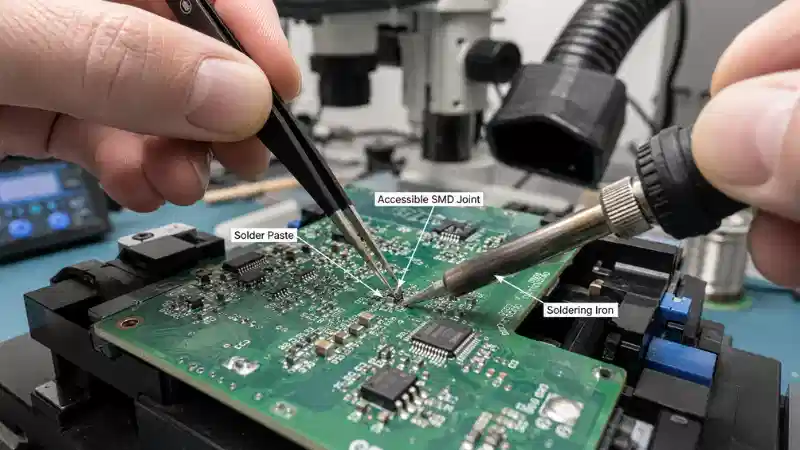
Wave soldering flux is a chemical agent applied to printed circuit boards before they contact the molten solder wave, serving to remove metal oxides from solderable surfaces while promoting proper wetting and intermetallic compound formation. The flux consists of activators, vehicles, and solvents-each component performing distinct thermochemical functions that determine whether a joint forms correctly or becomes another entry in your defect log.
The Oxide Problem Nobody Talks About First
Every metal surface exposed to atmosphere grows an oxide layer. Copper oxidizes. Tin oxidizes. The component leads sitting in that tube for six months in your stockroom-definitely oxidized. The oxidation happens continuously, starting the moment bare metal sees air, accelerating at elevated temperatures.
Solder doesn't wet oxides. It wets clean metal.
This fundamental incompatibility creates the entire reason flux exists. You're not adding flux because some spec sheet told you to. You're adding it because without chemical intervention, that 260°C wave of SAC305 will roll across your board accomplishing exactly nothing. The solder balls up, refuses to spread, and your through-holes emerge looking like someone tried to fill them with mercury.
I've watched operators stare at poorly wetted joints blaming alloy contamination, blaming dwell time, blaming the nitrogen flow-everything except the obvious. Check your flux coverage first. Ninety percent of wetting failures trace back to inadequate flux reaching the joint area.
Chemistry That Actually Matters
Rosin-based fluxes dominate wave soldering for reasons that go back centuries. The active ingredient-abietic acid, C19H29COOH-derives from pine tree resin through distillation and purification. This isn't sophisticated chemistry. Ancient metalworkers used pine pitch. The modern formulation just controls the variables better.
Abietic acid melts around 172-175°C, conveniently below traditional tin-lead eutectic at 183°C. The timing matters. You want flux activation preceding solder contact by fractions of seconds-long enough to strip oxides, short enough that the cleaned surface doesn't re-oxidize before solder arrives.
The activation mechanism involves acid-base reactions between carboxylic groups and metal oxides:
RCOOH + CuO → RCOO-Cu + H2O
The copper becomes bound in a rosin-soluble salt. The reaction products dissolve into molten flux and get carried away from the joint interface. Clean metal remains. Solder wets.
Lead-free changed everything about this timing. SAC305 liquidus sits at 217-220°C. That extra 35-40 degrees means your flux needs to remain chemically active longer before thermal decomposition renders it useless. Traditional rosin formulations designed for 63/37 processes frequently underperform at lead-free temperatures-they've exhausted their oxide-removing capacity before the solder even arrives.

The No-Clean Lie
"No-clean" doesn't mean "no residue." It means the residue theoretically won't cause reliability problems if left on the board.
Theoretically.
The reality involves flux manufacturers performing SIR testing at 85°C/85% relative humidity on IPC-B-24 comb patterns, demonstrating their residues maintain 100 megohm insulation resistance for 168 hours under controlled laboratory conditions. Whether that translates to your product surviving ten years in an automotive engine compartment or a industrial environment with actual contamination is another question entirely.
No-clean fluxes contain 1-5% solids content-mostly weak organic acids with perhaps some rosin or synthetic resin. The formulations deliberately sacrifice activity for residue benignity. The tradeoff works when your components have fresh, solderable surfaces. It fails spectacularly when procurement sources oxidized parts from that supplier in Shenzhen who stores inventory in a non-climate-controlled warehouse.
Every contract manufacturer I've worked with keeps a water-soluble flux on hand for the boards that no-clean refuses to solder properly. The official process documentation might specify ORL0 no-clean for everything. The production floor reality involves switching chemistries when defect rates climb.
Water-Soluble: When You Need The Activity
Water-soluble fluxes contain organic acids-adipic, citric, succinic-at activity levels that make rosin formulations look gentle. The higher acid content attacks oxides aggressively. Wetting happens fast. Hole fill improves. Joints look shiny.
The residues are also corrosive enough to destroy your product.
Not eventually. Not theoretically. Actively corrosive. Leave water-soluble residue on a powered board overnight and watch dendrites grow between traces. The ionic contamination creates conductive paths through moisture absorption. Electrochemical migration follows. Components fail.
Water-soluble processes require washing. Aqueous cleaning, typically at 140°F with DI water, removes the flux salts before they cause damage. Every board. Every time. No exceptions.
The cleaning step adds cost-equipment, water treatment, drying, ionic contamination testing. Manufacturing engineers hate it. But for thick boards with long barrel lengths, or components with heavily oxidized leads, or any situation where hole fill demands maximum flux activity, water-soluble remains the only chemistry that reliably works.
IPC J-STD-004 classifies these as ORH or even INH types. The "H" means high activity. The classification system exists specifically to warn people about corrosion potential.
Application Methods: Foam vs. Spray

Foam fluxing works by bubbling compressed air through a porous stone submerged in flux, creating a standing head of foam that contacts the board underside. The process has existed since the 1970s. It's simple, cheap, and reliable when properly maintained.
It also distributes flux unevenly.
The foam head collapses when boards with irregular bottom topography pass through. Large components glued to the solder side create shadows. Flux consumption varies with ambient humidity. The porous stone clogs with dried residue if anyone forgets to drain the reservoir before shutdown.
I've spent entire shifts troubleshooting foam fluxer problems. The stone blockage is the classic-manifests as reduced foam height, operators compensate by increasing air pressure, which creates unstable foam that collapses during board transit, resulting in spotty coverage that shows up as random skip soldering. The fix requires draining, cleaning, sometimes replacing the stone entirely. Meanwhile production stops.
Spray fluxing atomizes liquid flux through nozzles, depositing controlled quantities exactly where programmed. Coverage uniformity improves dramatically. Flux consumption drops because you're not maintaining a continuously evaporating foam reservoir. The process parameters-spray volume, traverse speed, air knife pressure-respond predictably to adjustment.
Spray systems cost more. They clog if someone uses flux with high solids content without adjusting maintenance schedules. But for any production volume justifying the capital expense, spray outperforms foam.
The newer ultrasonic atomization systems fragment flux into finer droplets than air-assisted spray, improving penetration into tight spaces. Whether that matters for your specific board design depends entirely on geometry.
The Hole Fill Problem
Lead-free solder doesn't fill holes like tin-lead did.
The physics involves surface tension and wetting speed. SAC305 exhibits higher surface tension than 63/37-roughly 500 mN/m versus 470 mN/m. The molten alloy resists flowing into narrow barrels. Capillary rise suffers. Topside fillets emerge thin or absent entirely.
Flux can partially compensate. Higher activity formulations reduce effective surface tension through better oxide removal, improving capillary action. Extended preheat ensures flux volatiles have fully evaporated before wave contact, maximizing the residual activator concentration at the critical moment. Slower conveyor speeds increase contact time, giving solder more opportunity to wick upward.
But there are limits.
Boards thicker than 0.093 inches with aspect ratios exceeding 8:1 challenge even aggressive flux chemistries. The barrel length simply exceeds what capillary action can accomplish in available dwell time. You either increase contact time until thermal damage threatens components, or accept incomplete fill as an unavoidable process limitation.
Some manufacturers address this with selective soldering for problematic joints. Others redesign pad geometry. Nobody has found a flux-only solution for high-aspect-ratio barrels with lead-free alloys. The physics won't permit it.
VOC-Free: Environmental Reality
Volatile organic compound regulations forced flux reformulation across the industry. Traditional alcohol-based fluxes emit isopropanol vapor during application and preheat-enough to trigger environmental compliance issues in jurisdictions with strict air quality requirements.
VOC-free formulations use water as the carrier solvent. They work. They also behave differently.
Water evaporates slower than isopropanol. Preheat zones require extension or higher temperatures to achieve equivalent solvent removal. The slower drying affects how flux distributes across irregular surfaces. Residue characteristics change because different carrier evaporation kinetics alter what remains after thermal exposure.
Switching from alcohol-based to VOC-free flux is never a drop-in replacement. Process requalification is mandatory. Anyone who tells you otherwise hasn't actually attempted the transition on a high-reliability product.

The J-STD-004 Classification System
IPC's flux classification scheme replaced the old military QQ-S-571 standards with a matrix of designators: composition (RO for rosin, RE for resin, OR for organic, IN for inorganic) combined with activity level (L/M/H for low/medium/high) and halide content (0 or 1).
So ROL0 indicates rosin-based, low-activity, halide-free flux. ORM1 means organic composition, medium activity, halides present.
The system helps compare products across manufacturers. It does not tell you whether a specific flux will work for your application. Two ROL0 fluxes from different suppliers can exhibit substantially different wetting performance because the classification measures specific test parameters-copper mirror, SIR, corrosion-not overall process capability.
Use the classification for initial screening. Trust your own qualification testing for production decisions.
Halides: The Necessary Evil
Halide activators-typically chloride or bromide compounds like diethylammonium chloride-dramatically improve wetting speed. They attack oxides faster than organic acid alternatives. For oxidized components or bare copper OSP finishes, halide-activated flux often makes the difference between acceptable process yields and constant rework.
The residues remain ionic. Under humidity exposure, halide residues absorb moisture and become conductive. Electrochemical migration accelerates. Reliability engineers document field failures traced to dendritic growth years after assembly.
High-reliability applications-aerospace, medical, military-often prohibit halide-containing flux entirely regardless of activity classification. Consumer electronics tolerates halides because product lifespans don't extend into decades and operating environments rarely combine high humidity with continuous power.
The choice involves explicit risk acceptance. Halides improve manufacturability at the cost of long-term corrosion potential. No-clean formulations with halides (L1, M1 designators) require particular scrutiny because the residue is designed to remain on the board indefinitely.
Flux Density Management
Liquid flux arrives from suppliers at a specified solids content-maybe 2% for spray no-clean, 15% for foam rosin. During use, solvent evaporates. Density climbs. Activity per unit volume increases.
Without monitoring, flux that started at 2% solids creeps toward 3% or 4%. Application volumes stay constant because nobody changed the spray settings. Boards receive significantly more active material than the process was qualified for. Residue levels exceed expectations. SIR compliance becomes questionable.
Every wave soldering operation should measure flux density daily. Refractometers work, though dedicated flux density meters provide higher accuracy. The measurement takes thirty seconds. The alternative is discovering during customer qualification audits that your process drifted outside specification six months ago.
Temperature Sensitivity in Storage
Rosin-based flux contains compounds with conjugated double bonds susceptible to oxidative polymerization. Store it warm, expose it to light, leave containers unsealed-the flux degrades. Viscosity increases. Wetting performance drops. What worked last month fails today.
Manufacturers specify storage between 15-25°C. They mean it.
I've seen production lines troubleshoot phantom soldering defects for weeks before someone checked whether the flux drums were stored next to the preheat exhaust duct. The flux had essentially cooked during storage. Fresh material from the same lot number performed normally.
Honest Assessment
Flux selection involves balancing activity against residue concerns, matching chemistry to your specific component solderability and board finish, then validating performance through actual production trials. Datasheet specifications provide starting points, not guarantees. The classification system offers vocabulary for discussing options, not predictions of success.
The fundamental job-removing oxides so solder wets metal-hasn't changed since ancient craftsmen discovered that pine pitch helped join bronze. Modern formulations optimize around contemporary constraints: lead-free temperatures, environmental regulations, high-density geometries, reliability requirements extending product lifespans.
When soldering fails, check flux first. Check coverage, check activation, check whether the chemistry actually matches your process conditions. The answer is usually simpler than anyone wants to admit.